Van Hall Larenstein University of applied sciences

TripleR – Restoring corals, grazers, and structure

The TripleR project investigates whether combining restoration strategies can improve outcomes. The approach integrates three components: coral restoration, grazer enhancement and the addition of structure.

TripleR – Restoring corals, grazers, and structure

9b. Restocking Diadema - Mika de Breuyn

The TripleR project investigates whether combining restoration strategies can improve outcomes. The approach integrates three components: coral restoration, grazer enhancement and the addition of structure.

Project

Project

To address the ongoing degradation of Caribbean coral reefs, the TripleR, short for Triple Restoration Approach, project develops and tests an integrated restoration approach that combines coral restoration, grazer enhancement, and the deployment of artificial structures. By addressing multiple ecological bottlenecks simultaneously, the project aims to improve reef recovery and increase ecosystem resilience.

Problem

Problem

Caribbean coral reefs have undergone a long-term shift from coral-dominated to algae-dominated states. This transition is driven by a combination of stressors, including climate change, disease, and overfishing, which have reduced coral cover and herbivore populations.

The loss of reef-building corals has led to a decline in structural complexity, reducing habitat availability for herbivores such as sea urchins and fish. As grazing pressure decreases, macroalgae proliferate and outcompete corals for space and resources. This creates a reinforcing feedback loop in which coral recovery is inhibited and reef degradation persists.

Conventional restoration approaches typically focus on a single intervention, such as coral outplanting, artificial reef deployment, or grazer restoration. While these approaches can be effective under specific conditions, they often fail on degraded reefs where multiple limiting factors act simultaneously.

How is the project addressing it?

How is the project addressing it?

The TripleR project investigates whether combining restoration strategies can improve outcomes. The approach integrates three components: coral restoration, grazer enhancement and the addition of structure.

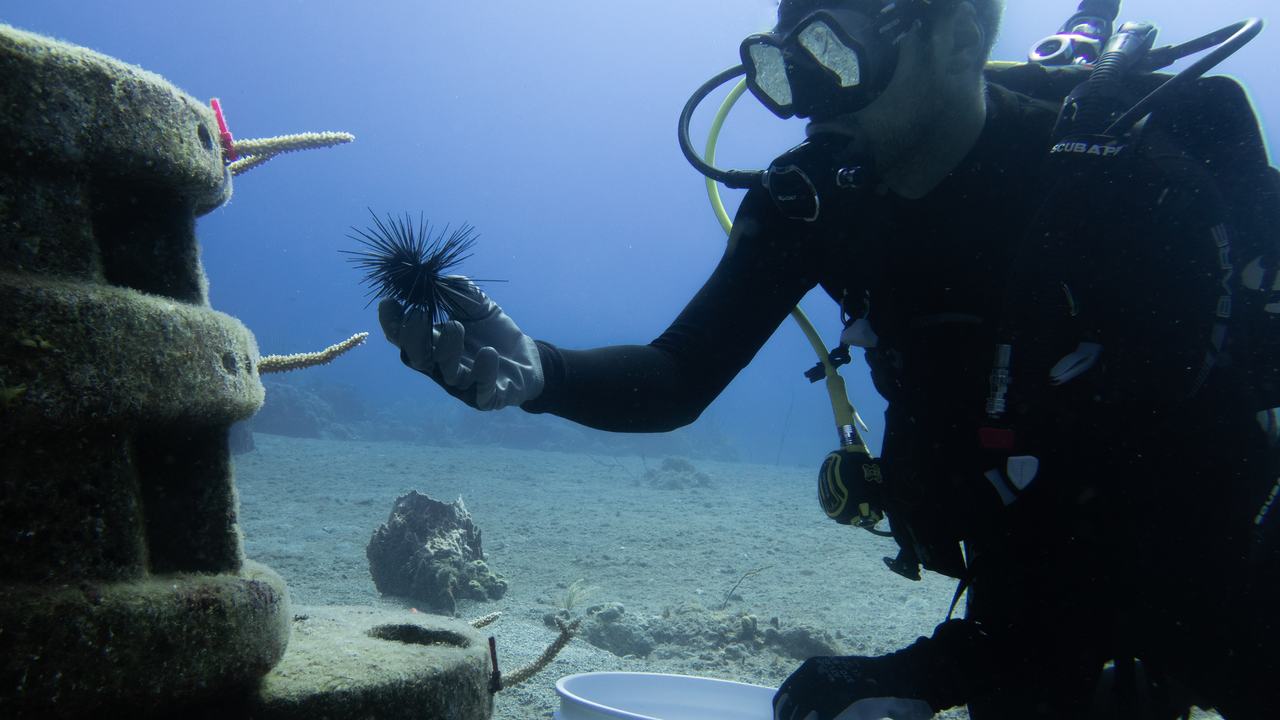
Artificial reef structures are designed to provide both substrate for coral settlement and shelter for grazing sea urchins. These structures are deployed on degraded reef areas and are simultaneously stocked with corals and herbivorous sea urchins.

The project focuses on understanding the interactions between these components. Field experiments are conducted at multiple locations to assess how environmental conditions influence outcomes.

The underlying assumption is that increased shelter improves grazer survival, which reduces algal cover and creates conditions that facilitate coral growth. Over time, this may initiate a positive feedback loop that supports reef recovery.

Deliverables

Deliverables

The TripleR project will provide insight into the effectiveness of combining coral, grazer, and structural restoration. The outcomes will be translated into practical guidelines for implementation and upscaling of restoration efforts. Results will be shared through scientific publications and collaboration with local and regional stakeholders to support evidence-based reef restoration.

Project Details

Project Details

Researchers

The TripleR project runs from 2026 till 2028 and is led by VHL researcher Alwin Hylkema. Other researchers involved in the project are Oliver Klokman, Roselle Spaargaren, Fleur Anteau, Luc Roozendaal, and Dennis Worst.

Participating Organizations

The project is carried out by a consortium including Van Hall Larenstein, React Foundation, Coastruction, Public Entity Saba, Saba Conservation Foundation, St. Eustatius National Parks Foundation (STENAPA), Wageningen University, World Wide Fund For Nature, Reef Renewal Bonaire, and Dutch Caribbean Nature Alliance.

Funding

The project is funded through the RAAK-publiek program and the participating partners.