Sods for the (Green) Dike
Research into whether dredging sludge is suitable for developing green, strong and biodiverse dike revetment.
Open days
-
Online Open Day
4 June



Research into whether dredging sludge is suitable for developing green, strong and biodiverse dike revetment.
Online Open Day
4 June
Online Open Day
4 June
Research into whether dredging sludge is suitable for developing green, strong and biodiverse dike revetment.
In the coming years, the Netherlands will face various challenges regarding water safety and water management. Due to climate change, we must anticipate rising sea levels and extreme water discharges in rivers. Consequently, many dike sections need to be reinforced by 2050. Recent years have seen various initiatives aimed at developing innovative and sustainable methods for strengthening water barriers. One finding is that a green, herb-rich grass cover on dike slopes is not only valuable for biodiversity but also more robust. A diverse species composition (with native herbs) roots deeper and better withstands dry periods.
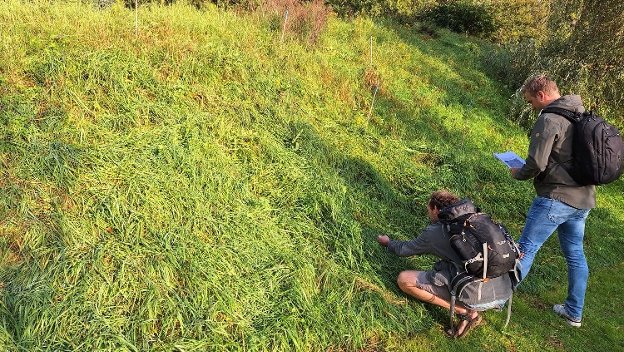
The project "Sods for the (Green) Dike" at Van Hall Larenstein University of Applied Sciences investigates whether dredged sludge is suitable for developing green, strong, and biodiverse dike coverings. This could be an excellent circular solution. Students from the Land and Water Management programme will conduct (small-scale) experiments at the Larenstein Estate in Velp, field trials with the sludge placed on the verge along the ditch of the Elderveld Food Forest (Arnhem South), and will carry out experiments together with the client, the Brabantse Delta Water Board.
See also the article by Den Hoven et al. (2024) about experiments with grass sods on the dike along the Hedwige-Prosperpolder.
Applied Research Group Leader: Jantsje van Loon-Steensma
Researcher-lecturers: Bram van Leeuwen, Erwin Roeterd, Ruben Baars, Dan Assendorp, Sylvia de Jager
Project Duration: 1 January 2024 – 31 December 2026
Project Partners: Brabantse Delta Water Board, VHL-Velp Garden Team, Wageningen UR, Elderveld Food Forest Foundation
SDGs: 13, 15