Sustainability
Sustainability is the cornerstone of everything we create and undertake together at Van Hall Larenstein University of Applied Sciences (VHL).
Open days
-
Online Open Day
4 June



Sustainability is the cornerstone of everything we create and undertake together at Van Hall Larenstein University of Applied Sciences (VHL).
Online Open Day
4 June
Online Open Day
4 June
Sustainability is the cornerstone of everything we create and undertake together at Van Hall Larenstein University of Applied Sciences (VHL).
It is not just hype, but the heart of everything we do. It permeates not only our teaching and research, but also our operations and collaborations. It is therefore by no means a coincidence that, since 2018, we have been named the most sustainable university of applied sciences in the Netherlands by the SustainaBul (the ranking of Dutch universities and universities of applied sciences in the field of sustainability). The ranking is based on the extent to which higher education institutions have integrated sustainability into their education, research and operations.
Both the Leeuwarden and Velp locations have their own Green Office. These are run by a club of enthusiastic students at VHL with the ultimate goal of making our university of applied sciences as sustainable as possible. Green Office is a member of the international student network Students for Tomorrow.
As a university of applied sciences, VHL places great importance on the intertwining of education and research to ensure that students can ultimately contribute to a better, more sustainable world as top-notch professionals. Real world assignments come in through the applied research groups and are taken up within the various degree programmes with the help of lecturer-researchers. In this manner, professors, researchers, lecturers and students provide innovative sustainable solutions to issues from (international) business and society in collaboration with practitioners from the professional field.
Through our institutional plan Growing as experts in transition, we continue our efforts to reduce energy and water consumption. Our multi-year sustainability plan addresses energy and water in all their aspects, including reduction, generation, origin and storage.
Our procurement and tendering policy has been overhauled in line with our institutional plan. With this policy, we promote the integration of social, ecological and economic aspects in the procurement and tendering of works, services and supplies (‘impactful procurement’).
Reducing waste starts with a well-considered procurement policy. Waste management (Reduce, Reuse, Recycle) is further addressed in our multi-year sustainability plan.
In dialogue with our caterer, we aim for a sustainable and more plant-based range of products, with a preference for seasonal and locally sourced produce. We seek a balance between a sustainable range and the associated costs.
Our sustainable travel policy for commuting is linked to ‘hybrid working’. VHL is committed to promoting a mix of on-site and home-based work for staff, wherever possible. In addition, VHL encourages staff to travel to campus in a sustainable way. Actual trips to campus are taken into account, with full reimbursement for public transport, supported by an NS travel card.
As a university of applied sciences with a strong international orientation, international cooperation is an important part of our education and research. Travelling to and from abroad is not a goal in itself, but a means of achieving objectives and/or activities set by the university. Our policy outlines how we justify international travel, without undermining the international impact we aim to achieve through education and research. The goal is for each employee to travel as sustainably as possible in the context of their work, by weighing up whether the journey is truly necessary and how it can be undertaken in the most sustainable way.
The world cannot exist without biodiversity. As space demands and environmental pressures put increasing pressure on biodiversity, biodiversity is central as one of the four transitions on which we are focusing. The importance of biodiversity is discussed in almost all study programmes. Our locations lend themselves well to this. Location Leeuwarden is located on the Potmarge, a small river that, together with the surrounding area, form the green lungs of Leeuwarden. Location Velp boasts the finest educational site in the Netherlands: Larenstein Estate. Since 2020, a food forest has been under development here in collaboration with Yuverta.
For VHL, inclusion means being able to be who you are, feeling valued and being able to be yourself in the workplace. It means feeling free to say what you want, with respect for others, of course, that there is room for differing opinions, and that equal opportunities exist for all. We believe that diversity in gender, age, sexual orientation, cultural and religious background, and work limitations enhances the quality of our education and research. Through an inclusive educational approach, we aim to contribute to equal opportunities and personal development for all students and staff.
The great challenge for a university of applied sciences today is to contribute positively, through education, research and collaboration, to the transitions that can reduce or even reverse the problems caused by humans. VHL always strives for collaborations with a positive impact, including with our bank, insurer or pension fund. After all, these involve substantial sums of money that can either support or hinder a sustainable world. This focus on sustainability is not a recent development, but has for years been a selection criterion in our partnerships with financial institutions.
The United Nations' 17 Sustainable Development Goals (SDGs) are and will remain important in our education and research programmes, support and facilities. However, in the current new phase of our development as a university of applied sciences, the SDGs come into a broader context. After all, extensive, sweeping transitions are required. Shaping these sustainable transitions is part of the magnification of sustainability: SDGs 2.0. Transitions are the key pillars in our institutional plan Growing as experts in transition.
For contact on sustainability matters, please email duurzaam@hvhl.nl.
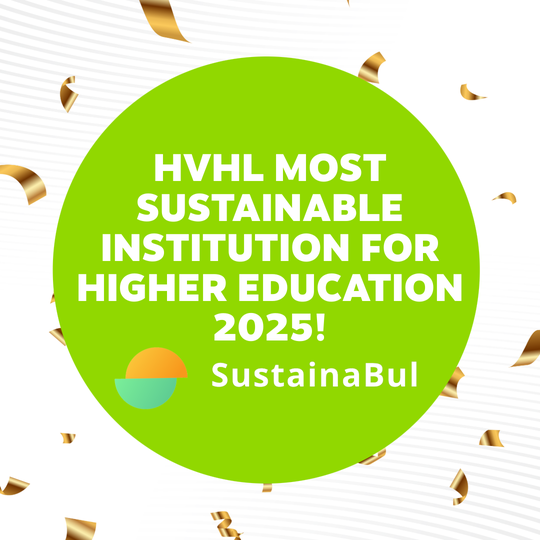
During the SustainaBul 2025 awards, Van Hall Larenstein University of Applied Sciences (HVHL) was named the most sustainable higher education institution in the Netherlands. For the fifth time (in 2020, 2022, 2023, 2024 and 2025) our university has earned this title.